All blog
Account Suspension
6 Min read

#Account Suspension
#Seller Compliance
#Account Health
Amazon Seller Account Suspended for Counterfeit in the USA: The Complete Recovery Guide
Amazon seller account suspended for counterfeit; inventory frozen. Discover how to spot fakes, write a valid appeal, and reactivate your business.
Table of Contents
TL;DR
An Amazon seller account suspended for counterfeit is a Section 3 enforcement action where Amazon assumes product inauthenticity until proven otherwise. Even genuine products can trigger this suspension if invoices, warranties, or the chain of custody cannot be verified. The result is immediate account deactivation, frozen funds, and inventory at risk of destruction—making documentation accuracy the deciding factor in reinstatement.
Introduction: Why “Counterfeit” Is Amazon’s Most Dangerous Suspension
It’s 6:15 AM. Mike, a wholesale reseller, opens his phone to check his overnight sales. Instead of the usual dashboard, he sees the notification every seller fears: “Your Amazon.com selling privileges have been removed.”
By 6:30 AM, he realizes the severity of the situation. His $45,000 disbursement scheduled for tomorrow is frozen. His FBA inventory—thousands of units sitting in Amazon warehouses—is now trapped, with a looming threat of disposal. He isn’t dealing with a simple operational glitch; he is dealing with an Amazon seller account suspended for Counterfeit, the single most aggressive suspension type in the Amazon ecosystem.
This is the reality of the “Guilty Until Proven Innocent” algorithm. In the United States, Amazon is under immense legal pressure to prevent counterfeit goods from entering the market. To protect themselves, they have tuned their bots to be ruthless. If a customer complaint, a competitor attack, or a random keyword scan triggers an Amazon account suspended counterfeit flag, Amazon does not ask for proof first—they evict you immediately.
Because these decisions are algorithm-driven, some sellers use monitoring tools like ave7LIFT® to track Voice of Customer trends and policy risk indicators before they escalate into Section 3 enforcement.
The “Death Sentence” of Amazon Accounts: Section 3
Most suspensions are like traffic tickets. If your Late Shipment Rate rises, you get a warning. If your Order Defect Rate (ODR) hits 1.5%, you get a suspension, but Amazon tells you exactly how to fix it.
A Counterfeit suspension is different. It triggers Section 3 of the Amazon Business Solutions Agreement (BSA).
Under Section 3, Amazon reserves the right to suspend Amazon seller account privileges immediately if it suspects “deceptive, fraudulent, or illegal activity.” Unlike performance suspension, where Amazon wants you to improve, a Section 3 suspension means Amazon believes you are a bad actor. They view your business as a legal liability.
The Risk: It is not just about losing sales for a week. It is about having your Amazon seller account banned permanently, the holding of your funds, and the destruction of your inventory.
The Challenge: You cannot simply say, “I didn’t do it.” You must provide a specific, legal chain of custody that satisfies an internal investigator who is looking for a reason to reject you.
If you are currently in Mike’s position—staring at a frozen account and wondering how to prove the authenticity of products you know are real—you need to stop, breathe, and put away the “Appeal” button for a moment. Rushing a generic response now can seal your fate.
If you’re unsure whether your account is suspended, denied, or permanently closed, read our Amazon Seller Account Suspended: Ultimate Reinstatement Guide, which explains each status and the correct recovery strategy.

1. What Does “Counterfeit” Mean Under Amazon Policy?
Mike’s first reaction to the suspension email was righteous indignation. "These aren't fake," he told his warehouse manager. "I have the invoices right here from a legitimate distributor in Ohio. These are genuine products."
He was right—they were genuine. But he was making a fatal error: assuming Amazon uses the dictionary definition of "Counterfeit."
In the real world, "Counterfeit" means a fake product meant to deceive (like a knock-off Rolex sold in a back alley). In Amazon’s world, "Counterfeit" is a catch-all term for any product where the Chain of Custody cannot be perfectly verified, or where the condition does not match the strict "New" guidelines.
Amazon’s Definition vs. The Legal Definition
Amazon operates on a "Zero Tolerance" policy. To protect themselves from lawsuits, they cast a wide net. If their AI detects even a slight discrepancy, they default to the worst-case scenario.
Mike discovered that while his product was authentic manufacturing-wise, he had an Amazon seller account suspended inauthentic status based on policy violations.
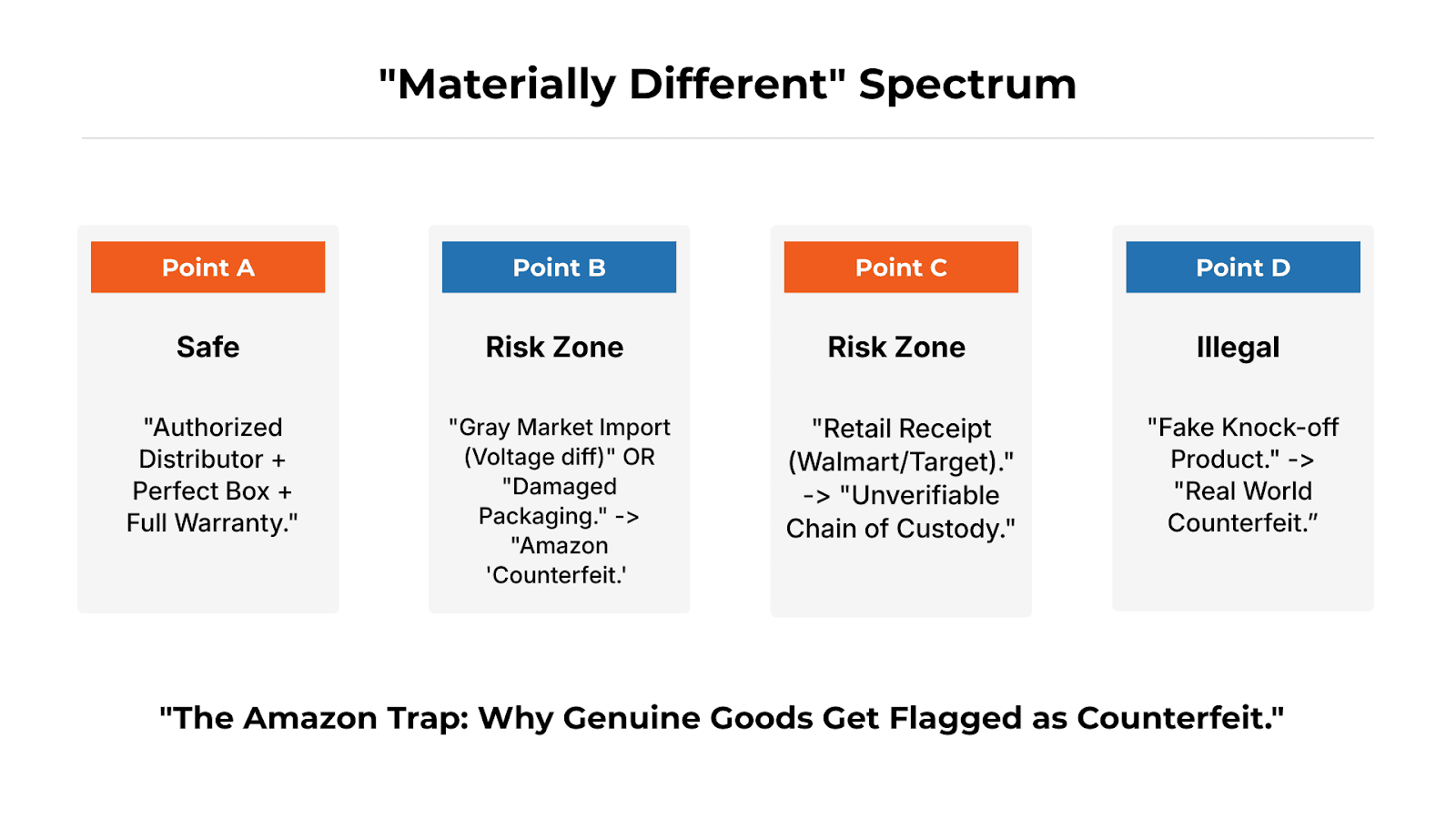
What Does "Materially Different" Mean?
This is the trap that catches 90% of honest sellers like Mike. Under US law (and Amazon policy), a genuine product can be considered "Counterfeit" if it is Materially Different from what the manufacturer intends for that specific marketplace.
The Warranty Trap: If Mike sells a vacuum cleaner as "New," the customer expects the full manufacturer’s warranty. However, if Mike’s distributor isn't on the manufacturer’s "Authorized" list, the warranty might not transfer to the final customer. To Amazon, a product without a warranty sold as "New" is materially different from the genuine article. Therefore, it is "Counterfeit."
Gray Market Goods: If Mike bought stock intended for the European market and sold it on Amazon.com, the plug or voltage might be different. Even if it’s made by the same factory, it is "Materially Different."
Counterfeit Suspension vs. Intellectual Property (IP) Complaints
It is critical to know who shot you.
IP Complaints: This comes from the Brand Owner (e.g., Nike files a complaint saying you aren't authorized).
Counterfeit/Inauthentic Suspensions: This often comes from Amazon’s own bots or customer feedback, leading to an Amazon account suspended inauthentic notification.
Mike wasn't sued by the brand; he was flagged by Amazon because a customer complained the item "looked used." Amazon’s system translated "looked used" into "Inauthentic/Counterfeit."
Conclusion
A counterfeit suspension is not a routine Amazon setback—it is a direct threat to your entire business. Section 3 enforcement is designed to protect Amazon, not sellers, and it operates on a ruthless “guilty until proven innocent” model. Funds are frozen, inventory is locked, and one poorly written appeal can permanently end years of work. As this guide makes clear, most sellers are suspended because their documentation, chain of custody, or response fails to meet Amazon’s legal standard.
Winning reinstatement requires precision, not panic: verified commercial invoices, clear authorization, and a carefully structured Plan of Action that speaks Amazon’s internal legal language.
This is where ave7LIFT® becomes essential. ave7LIFT® isn’t a template or a generic appeal service—it’s a 24/7 defense system for Amazon sellers. It monitors account health, Voice of Customer data, and policy risk indicators in real-time, alerting you before a counterfeit suspension occurs. And when enforcement does happen, ave7LIFT® connects you directly to human experts who know how to navigate Section 3 and recover accounts, inventory, and funds.
Summary
An Amazon seller account suspended for counterfeit in the USA is one of the most severe enforcement actions Amazon can take. Triggered under Section 3 of the Business Solutions Agreement, it operates on a “guilty until proven innocent” model, immediately deactivating the account, freezing funds, and locking FBA inventory, which is at risk of destruction. Crucially, these suspensions are not limited to fake products—genuine items can be labeled “counterfeit” if Amazon cannot verify the chain of custody, invoices, authorization, or if products are deemed materially different, such as lacking a valid warranty.
This guide explains how counterfeit suspensions are triggered, the difference between Amazon’s definition and legal counterfeiting, and why most appeals fail. It walks sellers through evidence requirements, invoice standards, Plan of Action strategy, inventory and funds recovery, and when professional help is critical. Ultimately, the key to reinstatement—and future protection—lies in airtight documentation, disciplined supplier vetting, and proactive monitoring to stop risks before Amazon’s bots shut your business down.
Frequently Asked Questions
More Insights from us