All blog
Amazon Compliance
Jan 7, 2026
6 Min read

#Security
#Account Ban
#Account Suspension
Why an Amazon Seller Account Buy Is the Fastest Way to Get Banned
An Amazon seller account Buy carries serious risks, suspensions, frozen funds, and related account bans. Learn why account transfers fail.
TL;DR
Buying an Amazon seller account may look like a shortcut, but it’s one of the fastest ways to trigger suspensions, frozen funds, stranded inventory, and permanent bans. Amazon prohibits account transfers, aggressively detects ownership changes, and ignores private contracts—making recovery and refunds rare. In most cases, reinstating or fixing an existing account is safer, faster, and far more sustainable than replacing it.
Why Sellers Are Tempted to Buy Amazon Accounts—and Why It Backfires
For serious entrepreneurs, time is the scarcest resource. Launching on Amazon today means navigating aggressive algorithms, intense competition, and restrictive new-seller limits that can stall momentum before it ever builds.
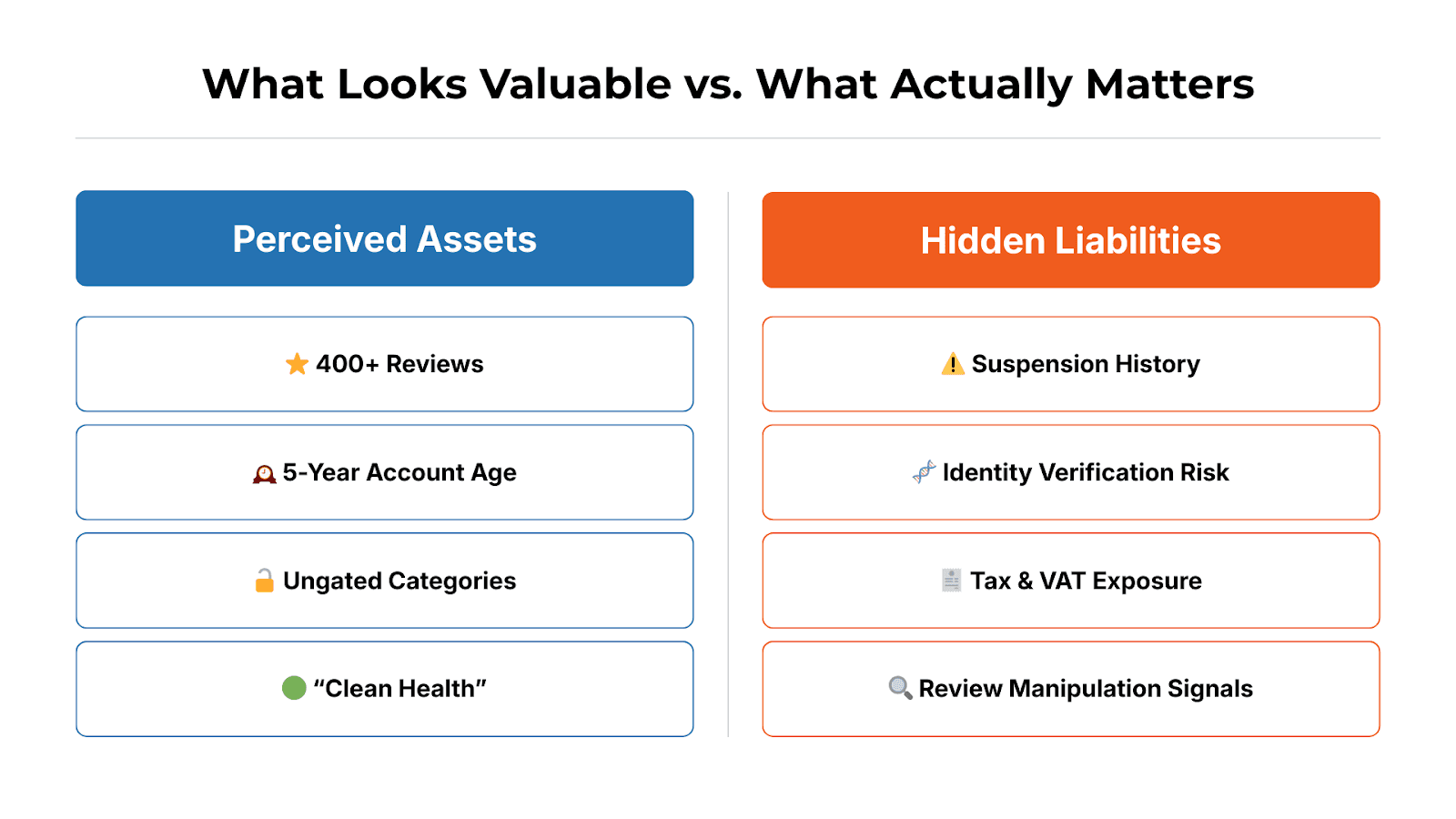
Alex is a seasoned e-commerce operator with a reliable supplier for organic skincare products (“Topicals”). While researching his next move, he comes across an offer in a private group: “5-Year-Old Amazon Seller Account. Ungated in Topicals & Pesticides. 400+ Reviews. Clean Health. $5,500.”
On the surface, it looks like the perfect shortcut.
In reality, the market for buying and selling Amazon seller accounts is opaque, unregulated, and extremely risky. An account’s apparent value isn’t defined by past revenue alone—it’s shaped by visible signals like reviews, age, and ungating approvals, and by hidden liabilities such as suspension history, policy violations, and verification weaknesses.
Most sellers who search “Amazon seller account buy” aren’t acting casually. They’re usually responding to pressure: a suspension, a failed identity verification, or repeated category ungating rejections. When revenue is frozen and time feels critical, buying an aged or ungated account can seem like the fastest way back into the marketplace.
But here’s the hard truth: Amazon explicitly prohibits the buying, selling, or transferring of seller accounts. What feels like a workaround often leads to permanent bans, frozen disbursements, and stranded inventory—sometimes within days.
This guide breaks down why sellers consider buying Amazon seller accounts, the real risks hidden behind those offers, and the safer, compliant alternatives that protect your business long term—before a short-term decision turns into permanent loss.
Before you risk inheriting hidden violations, run an ave7LIFT AI diagnostic. See what Amazon already sees—account risk signals, verification weaknesses, and policy exposure—before buying an account that could be suspended within days.

If your account is suspended or restricted, recovery is almost always safer—and often faster—than attempting to replace it. Amazon Seller Account Suspended: The Ultimate Reinstatement Guide.
1. Why Sellers Consider Buying an Amazon Seller Account
Sellers usually don’t wake up wanting to buy an account. They arrive here because something broke. The most common triggers include: Account suspension or Section 3 violations, Failed identity or INFORM Act verification, Repeated category ungating rejections, or New-seller velocity limits that restrict growth.
In these moments, marketplace listings advertising “aged,” “clean,” or “pre-ungated” accounts can look like a reset button. But that perception ignores how Amazon actually evaluates account risk.
Valuation Metrics: Age, Feedback, and Health
Just like credit history, an Amazon account’s "age" carries weight.
Account Age (The "Vintage"): Older accounts appear more stable on paper, but age does not override identity verification. Amazon re-verifies accounts continuously, especially after login, banking, or tax changes.
Suspension History: A "clean" account commands a premium. If an account has previously been suspended for Section 3 violations or dropshipping infractions, its value drops significantly—even if it was reinstated. Previously suspended accounts carry elevated enforcement risk and are more likely to be reviewed again in the future.
Feedback Score: High feedback counts inflate price—but reviews are not transferable trust. If Amazon detects review manipulation, inherited policy violations, or unusual behavior, those reviews are wiped, or the account is suspended entirely.
Category Ungating
Pre-ungated access saves time, but ungating approvals are not permanent shields. Ownership or operational inconsistencies often trigger re-evaluation.
In short, buyers aren’t purchasing safety—they’re inheriting unknown liabilities.
Inflated reviews often hide the biggest risk.
Buying an Amazon seller account doesn’t eliminate risk—it transfers it to you.
ave7LIFT AI identifies inherited policy violations, review manipulation signals, and verification gaps so you don’t buy a liability disguised as an asset.
2. Where Amazon Seller Account Buys Usually Happen (and Why That Matters)
Most Amazon seller account offers come from underground forums or private groups, where identities are unverified, and the risk of reclamation or suspension is high. Brokered listings may sell real businesses, but Amazon still ignores ownership transfers, meaning platform rules always override private contracts.
Brokerage vs. Black Market
Established Brokers (e.g., Empire Flippers, Flippa): These are the "Real Estate Agents" of the digital world. They vet sellers, verify profit and loss (P&L) statements, and facilitate the legal transfer of assets.
The Underground (Telegram & Forums): Black-hat forums offer speed and low prices. They are rife with stolen accounts and sellers who vanish the moment the crypto transfer hits their wallet.
Risks Of Using Telegram Groups For An Amazon Seller Account Buy
Alex is tempted by the Telegram deal because it is fast and cheap. But he needs to understand the "Telegram Tax": the lack of recourse.
The "Take-the-Money-and-Run": In unregulated chat groups, reputation is often faked using "vouches" from alternate accounts owned by the scammer.
Zero Support: If Amazon locks the account 24 hours after purchase (a common outcome following sudden ownership or behavior changes), a Telegram seller has no incentive to help Alex pass the identity check. They have already moved on to the next buyer.
In all the cases, Amazon’s systems respond to signals, not agreements.
3. Why Account Transfers Trigger Amazon’s Fraud Systems
Amazon evaluates patterns across access behavior, identity consistency, financial details, and operational activity. When multiple signals change close together, accounts are often flagged for review or suspended.
These signals are consistent with account takeover patterns, which is why many purchased accounts are locked or suspended shortly after transfer—sometimes before the first payout.
If your account shows “Account Under Review” or “Suspicious Activity,” timing matters.
ave7LIFT AI determines whether you’re facing a routine security check or an early-stage Section 3 enforcement—before the situation escalates.

4. Stealth Accounts: Why They Almost Always Fail
Some sellers advertise “stealth” accounts—profiles created using rented addresses, virtual cards, or borrowed identities.
These accounts: Rely on mismatched or unverifiable data, Fail video or address verification, or Collapse during INFORM Act or identity sweeps. Most stealth accounts last weeks or months, not years. When they fail, recovery is rarely possible because the documentation trail is fake from the start.
Stealth vs. Aged
Legitimate "Aged" Account: Was created by a real person or business, verified with real ID, and has simply gone dormant. This is a valuable asset.
"Stealth" Account: Was created using purchased/leaked identities and "ghost" addresses specifically to evade linking. These are ticking time bombs.
The Lifecycle of a Stealth Account
Stealth accounts are treated as disposable by the black market. They often operate for a short period before verification sweeps detect inconsistencies in identity or business data. If Alex plans to build a legitimate brand, buying a stealth account is like building a house on quicksand.
Most last months, not years, and recovery is rarely possible because the documentation trail is invalid from the start.
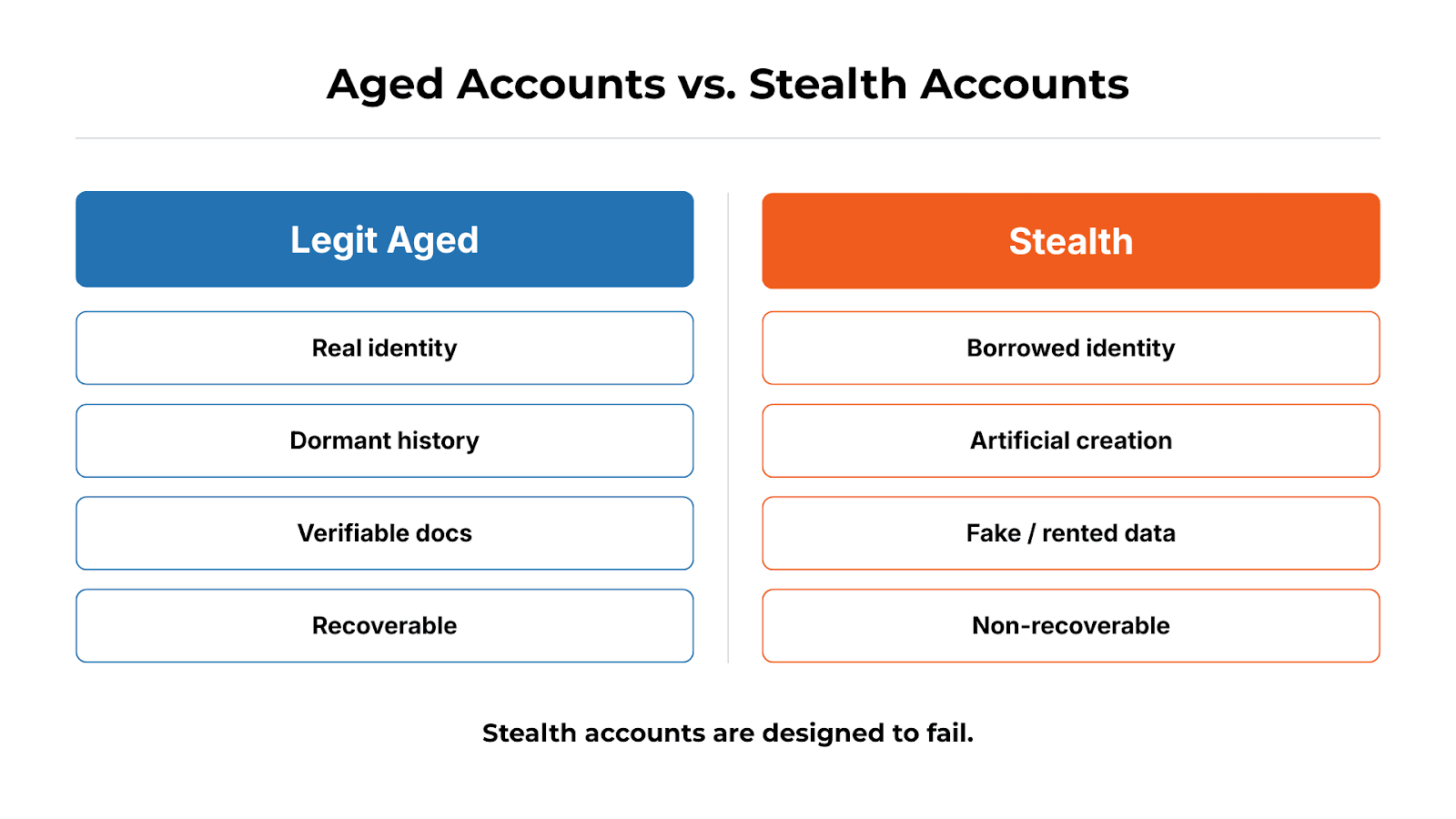
Stealth accounts fail because Amazon verifies identity first—not performance.
ave7LIFT AI monitors INFORM Act, identity, and verification signals so legitimate sellers can fix issues instead of cycling through disposable accounts.
5. Inventory Risks When an Account Is Bought
If an account holds FBA inventory, risk multiplies. Inventory can become stranded during reviews. Storage fees continue while sales are blocked, and Legacy A-to-Z claims affect your metrics, not the previous owner. Inventory tied to a suspended or reviewed account can quickly turn profitable stock into sunk cost.
Asset Transfer & Stranded Risks
Inventory in FBA is tied to the FNSKU (barcode) of the current listing. If the account transfer triggers a temporary suspension or "Review," that inventory becomes Stranded Inventory. It sits in the warehouse, racking up storage fees, but cannot be sold.
Inventory tied to a restricted account can quickly turn profitable stock into sunk cost.
Liability For Defective ProductsThe A-to-Z claim hits his ODR (Order Defect Rate). Buyers often underestimate the financial exposure created by legacy returns and A-to-Z claims, which can surface long after access changes hands. Without visibility into inventory status during enforcement reviews, sellers often discover issues only after fees and losses accumulate. |

6. Tax and Financial Liability Most Buyers Don’t See
When you take control of an account, you may also inherit: Unpaid sales tax or VAT, 1099-K reporting discrepancies, and Cross-border compliance obligations. In some regions, tax liability follows the account, not the operator. This is especially dangerous for EU-registered accounts.
Past Due Taxes
Does the previous owner owe $10,000 in unpaid sales tax to California? Or VAT to Germany? Amazon collects some taxes automatically, but not all. If Alex takes over the Legal Entity, tax authorities may come after the account for back taxes.
Verifying The P&L Statement
Sellers lie. It is easy to "Right Click -> Inspect Element" on a web page and change a $1,000 sales day to show $10,000 in a screenshot.
Buyers frequently underestimate how easily financial data can be misrepresented, making accurate verification difficult.
VAT Implications For EU Accounts
If Alex is buying a Europe-based account, the stakes are higher. EU laws enforce "Joint and Several Liability," meaning the new owner can be held personally liable for the VAT fraud of the previous owner.
In some regions, tax liability follows the account, not the operator—particularly in the EU, where joint liability rules apply.
7. Why “Cool-Down” Strategies Don’t Protect Accounts
Many buyers believe that going slow after acquisition reduces risk. In reality, Amazon evaluates consistency, not patience. Dormant accounts that suddenly: List new ASINs, Change fulfillment patterns, or Scale revenue quickly still raise flags. Behavior mismatches—not speed alone—drive enforcement.
8. What Happens When an Amazon Seller Account Buy Fails
When an Amazon seller account purchase goes wrong, the outcomes are rarely minor. The most common consequences include:
The original owner is reclaiming the account
Amazon is suspending the account for policy circumvention
Funds frozen during investigation
Because Amazon explicitly prohibits account transfers, legal recourse is extremely limited, especially when transactions involve overseas sellers or informal agreements.
Seller Clawbacks: The Most Common Scam
One of the most frequent failure scenarios is a seller clawback.
In these cases, the seller accepts payment, provides temporary access, and waits for a short period. They then contact Amazon Seller Support, claiming the account was hacked or that their email was changed without authorization. Because Amazon recognizes the original creation details and historical access patterns, the platform often restores control to the original owner.
The buyer is locked out permanently—and the money is gone.
Can You Sue if the Deal Goes Bad?
Buying and selling Amazon seller accounts sits in a legal grey area. While the transaction itself may not be illegal, it typically violates Amazon’s Terms of Service due to the non-transferability of seller licenses.
This makes enforcement of contracts difficult. If the seller is located in another country, jurisdictional barriers make recovery efforts even less realistic. In practice, most buyers have little to no legal leverage once access is lost.
Why “Looking Under the Hood” Matters
Buying an Amazon seller account can look like a fast track to success—but without full visibility into risk, enforcement signals, and account history, it often becomes a permanent setback.
If you’ve already purchased an account—or are struggling to manage the health of your current one—operating blindly is the biggest risk of all. ave7LIFT AI provides continuous diagnostics, early-warning alerts, and account health monitoring to help sellers detect issues before Amazon enforcement escalates into shutdowns.
Secure your account health before a warning becomes a permanent loss.

Conclusion
Buying an Amazon seller account may look like a fast track, but on Amazon, speed without control is often what triggers collapse. An account is not a transferable login—it is a living risk profile, continuously scored by automation that punishes inconsistency, undocumented changes, and inherited violations. What appears to be instant access to reviews, ungated categories, or account age can rapidly turn into frozen funds, stranded inventory, or a permanent Section 3 ban.
Alex’s story highlights the real danger: the highest risk begins after the credentials change hands. Valuation assumptions, tax exposure, operational behavior, and post-transfer changes are heavily scrutinized during this period. One missed signal or unexplained shift is enough to trip Amazon’s enforcement systems.
This is where most buyers miscalculate. They treat acquisition as the finish line, when in reality it opens the most fragile window of the account’s life. ave7LIFT AI exists for this exact moment—providing continuous visibility into account health, detecting early warning signals, and guiding sellers through Amazon’s automated enforcement before a warning becomes a shutdown.
If you’re considering an Amazon seller account buy, the real objective isn’t ownership—it’s survival. And if your business is already stuck, the answer isn’t replacement—it’s resolution. The difference between growth and permanent loss is early detection, disciplined execution, and expert intervention—before Amazon decides for you.
Summary
Buying an Amazon seller account is not a workaround—it’s a compliance violation that frequently results in suspension, frozen funds, and irreversible bans. Amazon does not recognize private account transfers and aggressively detects ownership inconsistencies through identity, behavioral, and financial signals.
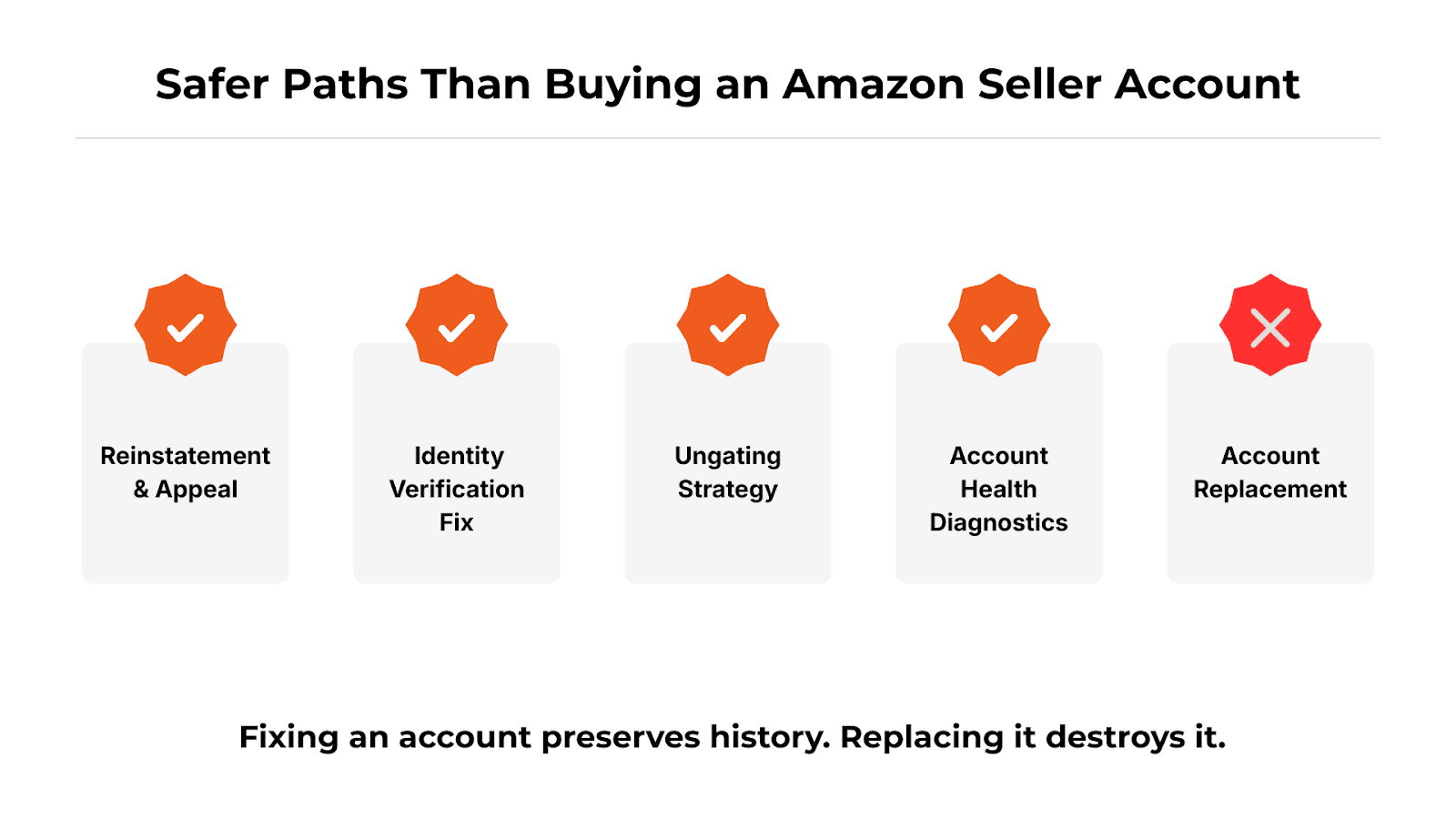
Sellers searching for “Amazon seller account buy” are usually reacting to a deeper issue—suspension, failed verification, or ungating denial. In most cases, diagnosing and fixing the root cause of the original account problem is safer, faster, and more sustainable than attempting replacement.
Proactive monitoring and early diagnostics significantly reduce enforcement risk and help sellers recover without compounding losses.
Amazon account buy is not just a transaction, but a fragile transition that must be managed carefully. Tools like ave7LIFT AI provide continuous monitoring and early-warning protection, helping buyers detect issues before Amazon’s automation shuts the account down overnight.
Frequently Asked Questions
More Insights from us